1860 New Hebrides, Pacific Ocean.
Nothing had prepared Lady Katharine Montgomery for the jumble of feelings overwhelming her when Alex worshipped her body, first with words and later with his hands and mouth. For years around this house, she’d been forced to appear dowdy, unintelligent, and totally self-effacing to never anger her father, or draw his wrath. Now, though, every degrading restriction was lifted from her mind, body, and life.
Her father was dead. Yesterday, she’d buried her hatred for the despicable man who’d given her life during the quarter hour it took to stand at his grave and, along with all the other hypocrites present, pretend to mourn as they buried his mortal remains. He’d cheated traders, beaten plantation workers, and horse-whipped her within an inch of her life. She and all the other mourners hoped he’d rot in hell.
Last night, she’d felt free to liberate the passionate nature she’d kept buried for six and twenty years for fear of her father’s explosive wrath. But one night with Lord Alexander St. John had changed everything. One night with a lover who was gentle and caring had her aching for more, more of Alex and more of life with him.

Sunday Snippet: 1860 New Hebrides (Vanuatu), South Pacific. Yesterday, Lady Katharine buried her despicable father. #SundaySnippet #HistoricalRomance #HistoricalMystery #Vanuatu books2read.com/suziloveLLK

“Two nights ago,” Lady Rebecca Jamison said, “the woman we engaged at the Women’s Betterment Society to tally the Stock Exchange ledgers — our friend — was murdered. The killer was still inside Peggy’s house when I arrived. Her slayer stopped at the back door and stared directly at me, memorizing my features.”
Her pronouncement was flat-voiced, deadly calm.
“Thankfully, his immediate concern was escaping with our two accounting books. But when the cache identifies me as the woman who saw their lackey’s face, I am certain they will send him to dispose of me as well. They are peers, titled and wealthy, and cannot risk being exposed as members of an illegal group. If we cannot stop these men, brutes who employ cold-blooded assassins to do their dirty work, I will certainly be the next to die.”
The Duke of Sherwyn’s chilled blood turned to ice.
Embracing Scandal, Scandalous Siblings Book 1. https://books2read.com/suziloveES

Sunday Snippet: Embracing Scandal: “Two nights ago,” Lady Rebecca Jamison said, “the woman we engaged at the Women’s Betterment Society to tally the Stock Exchange ledgers was murdered. #ReadARegency #VictorianRomance #HistoricalMystery #HistRom
Tweet

Drama and romance at the Duke Of Sherwyn’s snowbound country estate in the English countryside in December. Michael Brandon travels to introduce the woman he loves to family but is shocked when his missing brother, presumed dead for years, arrives at the country estate of the Duke Of Sherwyn where several people are stranded due to a severe snow storm. https://books2read.com/suziloveDS December Scandal, Book 3 Scandalous Siblings.

Drama and romance at the duke’s snowbound British country estate in December. #mystery #FamilySaga #HistoricalRomance https://books2read.com/suziloveDS

Brenton, Lord Mallery, sniffed again. Shook his head in denial. Ridiculous to imagine Lillian, his Lillian, was the wearer of that country orchard scent. Or to picture her here, at a pleasure house ball. Bloody hell, perhaps his family’s worst fears had become a reality and he’d morphed from a recluse into a madman.
His cousin, Michael, stared at him and snorted. ‘What on earth are you doing?’
Brent shook his head again. ‘Must be imagining things. I know only one person who wears that perfume and she mixes it herself, her own blend of citrus fruits. That woman is a lady and a duke’s daughter and certainly wouldn’t be attending a courtesan’s ball.’
‘Good God! You don’t mean−’
SundaySnippet: Lord Mallory said, ‘That lady wouldn’t be attending a courtesan’s ball.’ #RegencyRomance #HistRom #ReadARegency #EroticRomance books2read.com/suzilovePHB
Tweet

1819 White Dress With Short Sleeves Styled after the Court of France. #Bridgerton #RegencyEa #JaneAusten #HistoricalFashion
1819 White Dress With Short Sleeves, English. Styled after the Court of France. Yellow skirt with long train decorated with flowers. Flowered headdress, long white gloves, necklace.Fashion Plate via John Belle’s La Belle Assemblée or, Bell’s Court and Fashionable Magazine, London.

1819 White Dress With Short Sleeves Styled after the Court of France.#RegencyEra #JaneAusten #Fashion https://books2read.com/SuziLoveFashionWomen1815-1819

Are you a Bridgertons fan? Love Jane Austen? Love history? Take a look at a Young Gentleman’s Day in early 1800s. Young Gentleman’s Day Regency Life Series Books 2 by Suzi Love. Easy to read books on what a young gentleman did, wore, and lived during the early 1800s, or the Regency Era when King George 3rd was mad and his son, Prince George, was the Regent in Britain. #Regency #JaneAusten #amwriting books2read.com/suziloveYGD

Are you a Bridgerton fan? Love Jane Austen? Take a look at a Young Gentleman’s Day in early 1800s. #Bridgertons #Regency #JaneAusten #Nonfiction. http://books2read.com/suziloveYGD

Pleasure House Ball Book 3 Irresistible Aristocrats. Love revealed at a courtesan’s ball. Brenton, Lord Mallory, attends his first courtesan’s ball in ten years to appease his concerned friends, though he’d rather stay home and read to his motherless daughters. Leaning in, Lord Mallory whispered in Lady Lillian’s ear. “Well, well. I certainly didn’t expect to find you in attendance at a scandalous ball.” Pleasure House Ball Book 3 Irresistible Aristocrats. books2read.com/suzilovePHB

Lord Mallory whispered in Lady Lillian’s ear. “I didn’t expect to find you in attendance at a scandalous ball.” #ReadARegency #RegencyRomance #HistRom #EroticRomance books2read.com/suzilovePHB
1815 March High-Waisted Brown Promenade Dress and Flowered Hat. #RegencyFashion #JaneAusten #HistoricalFashion
1815 March Brown Promenade Dress, English. High-waisted dress with decorative hem, white sleeves, white fichu, blue scarf, brown hat decorated with flowers. Jane Austen and her contemporaries would have worn this style of outdoor walking outfit and flowered hat. Fashion Plate via The Lady’s Magazine Or Entertaining Companion for the Fair Sex.
Definition: Redingote (réd’ing-göt; red ing gote). Woman’s long, fitted coat often worn open in front to show off the dress underneath. Sometimes cut away in front. Originally made with several capes and trimmed with large buttons. French word developed from English words, riding coat. reefer. Single- or double-breasted, fitted, tailored, over-all coat usually made from sturdy fabric.
Fichu – A piece of lace, muslin, or other cloth worn about the neck and cleavage to preserve a lady’s modesty. From French word meaning neckerchief.

1815 March High-Waisted Brown Promenade Dress and Flowered Hat. #RegencyFashion #JaneAusten #HistoricalFashion https://books2read.com/SuziLoveFashionWomen1815-1819
1818 Gorgeous women’s fashion In the times of Jane Austen. Dresses, coats or Redingotes, Spencers, shawls, fichu or shoulder cape, shoes, hats and headdresses, gloves, and Reticules or bags as displayed in various fashion magazines.
- Morning Dress: Worn either at home, out shopping, or for walking in the park or country. Presentable but not overly accessorized.
- Afternoon Dress: Dress made from the best fabric and beautifully decorated to see and be seen in when visiting friends, going to a museum or attending a daytime public event.
- Walking Dress: Worn out shopping, walking in a city park or the country estate. Presentable and warm, more fashionable than Morning Dress but accessorized for sun protection and warmth, rather than display.
- Promenade Dress: Includes gown, hat, and other accessories and more styled and fashionable than morning or walking dress. An ensemble designed to see and be seen in.
- Evening Dress: Minute distinctions between ball, dinner, evening and opera gowns meant different quality of fabrics, designs, and embellishments.
- Ball Dress: Gown of expensive silk fabrics, light or heavy, decorated with lace, embroidery or beading, with low-cut bodice, short or barely-there sleeves, and full skirts. Often shorter length skirt for dancing.
- Empire Dress: Light and flowing dresses with waists just under bust worn during French Empire Period, or early 1800s.


1818 Gorgeous Women’s Fashion In The Times Of Jane Austen. #Regency #JaneAusten #HistoricalFashion https://books2read.com/SuziLoveFashionWomen1815-1819
1800s Road Travel In Jane Austen and Bridgerton Times. #Bridgerton #RegencyEra #JaneAusten #BritishHistory #Travel
For many centuries, road travel was the main way of getting from place to place, but roads were notoriously rutted and badly maintained, especially in Britain. The Romans laid down the roads but they very poorly maintained through the 17th and 18th Centuries. It wasn’t until the 19th Century that improvements were made and rose travel opened up.
Roman Road Construction. Roman roads were constructed in layers. Rubble, slabs of stone, pebbles and gravel, smooth paving stones. Average width of road was 15 to 18 feet.

The dreadful condition of British roads caused great apprehension to all classes of travelers. Making a journey anywhere in the country was a big undertaking and often a gentleman composed his last will and testament before his departure. Traveling in vehicles was only possible during the day or on the nights with very bright moonlight with few vehicles attempting road travel in winter and any travel on a Sunday was frowned upon.
From: 1815 Journal of Tour of Great Britain by a French Tourist via Google Books (PD-180) ‘The roads very narrow, crooked, and dirty, continually up and down. The horses we get are by no means good, and draw us with difficulty at the rate of five miles an hour. We change carriages as well as horses at every post house. They are on four wheels, light and easy, and large enough for three persons. The post boy sits on a cross bar of wood between the front springs, or rather rests against it. This is safer, and more convenient both for men and horse, but does not look well and, as far as we have seen, English post horses and postillions do not seem to deserve their reputation.’
If you’ve read Jane Austen you’ll know that it was improper for a woman to travel alone, which meant that well-bred women were dependent on male relations to accompany them or else they had to take a maid in the carriage with her and be accompanied by a driver and footmen, which of course added to the cost of carriage travel. Any woman traveling by herself on a mail coach would be subject to speculation and probably malicious gossip.
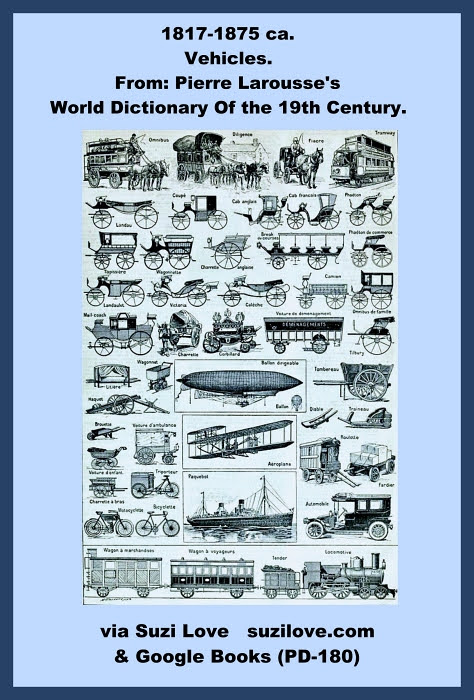
Mail coaches raced across these roads trying to stick to a time table but there were numerous accidents on roads that were often flooded, covered in snow, or up such steep hills that passengers had to alight and either push the coach or walk ups the hill.

Tolls were collected on many roads in Britain but, because the turnpikes were mainly on land belonging to the nobility, money collected went into their personal coffers and very little went to road maintenance. This caused a continual push in parliament to make those who owned the land and collected the money responsible for repairing their roads, but these pleas fell on deaf ears as the lords in who sat in parliament had no interest in spending money to better travel for the common people.
Description of Stage Coach Travel in England. via 1815 Journal Tour of Great Britain.
“The gentlemen-coachmen, with half-a dozen great coats about them,—immense capes,—a large nosegay at the button-hole,—high mounted on an elevated seat,—with squared elbows,—a prodigious whip, beautiful horses, four in hand, drive in a file to Salthill, a place about twenty miles from London, and return, stopping in the way at the several public-houses and gin-shops where stage-coachmen are in the habit of stopping for a dram, and for parcels and passengers on the top of the others as many as seventeen persons. These carriages are not suspended, but rest on steel springs, of a flattened oval shape, less easy than the old mode of leathern braces on springs. Some of these stage coaches carry their baggage below the level of the axletree.”

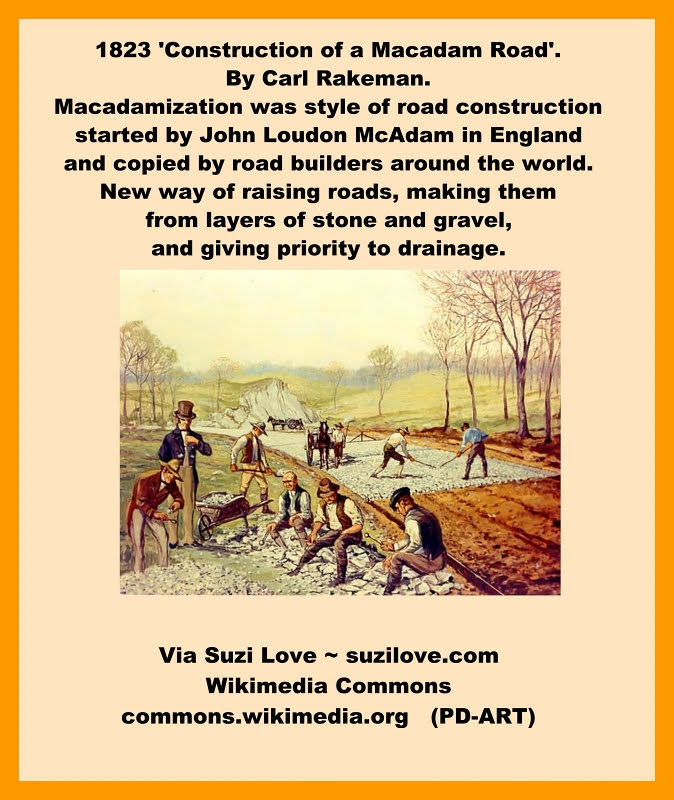
John Loudon McAdam, born Ayr, Scotland. (1756 -1836) He acted as a magistrate and assumed other civic roles including one as as trustee of the Ayrshire Turnpike in 1783, where he developed an interest in road construction and engineering, eventually becoming general surveyor for the Bristol Corporation in 1804. He wrote papers on the benefits of raising roads, making them from layers of stone and gravel, and giving priority to drainage. However, no roads were made this way until McAdam was put in charge of remaking the Bristol Turnpike in 1816, when he put his theories into practice and demonstrated macadamization, known as macadam. He made him numerous enemies on the Turnpike Trusts, who preferred to keep the money made from tolls rather than ploughing it back into road improvements but Macadam was soon in widespread use.

1825 John McAdam Observation of English Roads. “In a Country like England, inhabited by an ‘ intelligent people, well educated, active, and enterprising, where every hint at improvement is eagerly caught at and prosecuted with spirit, it is only possible to account for the apathy respecting Roads, and the want of exertion in prosecuting the means given for improvement, by showing that a strong counteracting principle exists in the defects of the Road Laws, and that although much want of encouragement has arisen from the prejudices of old practitioners— the great obstacle to success remains in the zealous opposition of those who profit by mismanagement in various ways.”
McAdam Report on Bristol District Roads, March, 1815.
- Expenditure and Debt.
- • 1802 – 1812 only two roads maintained themselves.
- • Neither able to pay £100 of the debt they owed.
- • No other roads supported themselves at all.
- McAdam’s List of Reasons for Bad Roads.
- • Ignorance and incapacity of Surveyors
- • Lack of any control over the lavish spending of Road Trusts
- • Trust accounts being in an inexplicable mess
- • No system or scientific mode of constructing roads
- • Every part of a road being differently formed
- • Each road managed by a different person
- • Each area managed by a different Turnpike Trust
- • Winford Road Trust produced no account books
McAdam informed the Road Trusts that smooth roads were the most useful and lasted longer because carriages do little damage to a smooth road because the horses exert themselves less and the carriages do not rock and roll.
Unfortunately for travelers in the late 1700s and early 1800s, the smoothness of a road surface depended on the preparation and distribution of the road building materials used and was therefore entirely in the hands of each individual road-maker. In 1816, Mc Adam reported to the Bristol District the difference in revenue if roads were built of good material, regularly maintained, and if the finances of Turnpike Trusts were under someone’s control.
Travel on these roads was also dangerous as highwaymen stopped and robbed anyone who came along. Male or female made no difference to highwaymen in Britain, nor to the bushrangers in Australia or the gangs on American roads, as they robbed indiscriminately and often with violence.
By the end of the 18th Century, however, travel as a pleasurable pursuit came into vogue and numerous guides were written for traveling all over the British Isles as well as on the continent.
The 1812 ‘Tour Of Dr. Syntax’ was an ironic look at the new obsession of travel and travel guides. Before he set off for the Lake District, Dr. Syntax said to his wife, “You well know what my pen can do, and I’ll employ my pencil too: I’ll ride and write, and sketch and print and thus create a real mint: I’ll prose it here, I’ll verse it there and picturesque it everywhere. I’ll do what all have done before; I think I shall and somewhat more.”
Georgian and Regency travelers were envious of aristocrats, even if they were of the nobility themselves, and loved to view all the British Great Houses.
A gentleman and his wife would even drive up to the front door of a mansion house and demand to be given a tour of the house. If they weren’t admitted, they would write in their journals of the inhospitable nature of the people on a particular estate. Thomas Pennant, William Mavor, and others, loved to write about these bad experiences and have them published. Paterson’s British Itinerary, a travel guide had 17 editions between 1785-1832 – it outlined the roads used by the stage and mail coaches, the tolls, the bridges, etc.
This new touring craze created an industry of hospitality that encompassed more than simple mail coach trips from place to place, and more than a noble family traveling from their country seat to the Metropolis of London for parliamentary sittings. Inns had to improve the quality of the linens and meals if they wanted to attract the wealthier traveling class. Before that, many travelers carried their own linen, crockery, glasses, and utensils, as they didn’t trust the hygiene or standards of country inns.
Travel became something written about by poets with many sonnets written to the beauty of places like the Lake District in England, or the pyramids in Egypt. Inns became cleaner and more respectable so they could welcome travelers of the upper classes. This also meant that women could travel more as roads were slowly improved from rutted tracks that were only suitable for horse riding to roads that family coaches could travel along, though these roads were still narrow and subject to extremes of weather, such as flooding. The race was on to travel from places like London to Edinburgh in the fastest possible time.

Road Travel In Jane Austen and Bridgerton Times. #Bridgerton #RegencyEra #JaneAusten #BritishHistory #Travel books2read.com/SuziLoveTravel


 Suzi Love